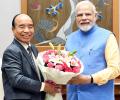
At 79, Zoramthanga is working to rebuild his image as the people's CM.

Prime Minister Modi, who is in Japan on a two-day visit to attend a summit of the Quad leaders at the invitation of his Japanese counterpart Fumio Kishida, penned an op-ed on the vibrant relations between India and Japan in the Yomiuri Shimbun.

With Lok Sabha elections months away, the visits are vital politically as these would showcase Modi's standing as a world leader to the home electorate.
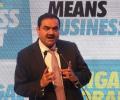
Asia's richest man Gautam Adani, besides looking at opportunities to expand his vast empire, is hooked on ChatGPT - the programme that trawls vast amount of information to generate natural-sounding text on virtually anything - from crafting jokes to writing ad copy, debugging computer code, to even generating poems and essays. Adani, whose conglomerate has in recent years diversified from mines, ports and power plants into airports, data centres and defence, penned musing from his visit to Davos to attend the World Economic Forum meeting. "From a meetings perspective, this was perhaps my busiest WEF as I met over a dozen heads of states and several business leaders," he wrote on LinkedIn, talking of new geopolitical couplings, climate change and tight-lipped evangelists and AI.

Billionaire Gautam Adani's group was on Thursday hit by fresh allegations of associates of the promoter family using Mauritius-based 'opaque' investment funds to secretly invest hundreds of millions of dollars to fuel the spectacular rise in group stocks during 2013 to 2018, a charge the conglomerate denied vehemently.

Prime Minister Narendra Modi's visit to South Korea is considered essential in strengthening defence ties, enhancing economic cooperation and forging cultural ties between the two countries, says Dr Rahul Mishra

The former Chief of Army Staff said India faces the most complex threats and challenges spanning a full spectrum of possible conflict -- from nuclear to sub-conventional -- but asserted that the armed forces are ready to deal with them.
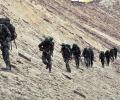
The report said that Indian officials believe China is trying to contain India by forcing it to divert more resources into defending simultaneously both its western border with Pakistan and eastern flank with China and by weakening its willingness and ability to challenge Chinese ambitions to dominate the region.

The last meeting of the 2+2 was held in New Delhi and the next meeting is to be hosted by the US in Washington, DC.
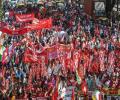
A joint forum of central trade unions has given a call for a nationwide strike on March 28 and 29, to protest against government policies affecting workers, farmers, and people. The Joint Platform of central trade unions held a meeting in Delhi on March 22, 2022, to take stock of the preparations in various states and sectors for the proposed two-day all India strike on 28-29 March 2022 against "the anti-worker, anti-farmer, anti-people and anti-national policies" of the central government, a statement said. The statement said that roadways, transport workers and electricity workers have decided to join the strike in spite of the impending threat of ESMA (Haryana and Chandigarh, respectively). Financial sectors, including banking and insurance, are joining the strike, it stated.

In a veiled reference to China's aggressive military behaviour, Defence Minister Rajnath Singh on Thursday said exercising self-restraint in the conduct of activities and avoiding actions that may further complicate situation will go a long way in bringing sustained regional peace.

Prime Minister Modi appreciated the vision of Putin for the welfare for Russia's Far East, saying the Russian President has opened up investment opportunities for India in the region.
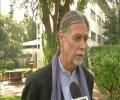
Putin's idea was to attack his neighbouring country, he has to stop and then only we can find a solution, said the German ambassador.
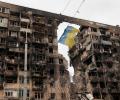
The Americans have expended a lot of diplomatic energy to coax India into toeing their line but India has refused to buckle under pressure. As Foreign Minister Subrahmanyam Jaishankar said, India has not taken anyone's side but its own side, points out Virendra Kapoor.

The unions term the introduction of fixed-term employment as a 'modern labour slavery system' introduced through the 'back door'.
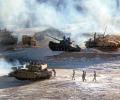
'India cannot allow Beijing's policy of stabilising and destabilising the border at will to perpetuate its own ends.' A riveting excerpt from Manish Tiwari's 10 Flashpoints; 20 Years National Security Situations That Impacted India.

The seventh Tibet Work Forum was held in Beijing on August 28 and 29. Delhi should be deeply concerned, at a time India faces a precarious situation in Ladakh, because the TWF also defines China's western border policies, observes Claude Arpi.

"China has increased their military capabilities and spending more on defence," Defence Minister A K Antony said at a Security Forum in Singapore

'NSA Doval and the PM are known to admire Israel's tough response to cross-border terrorism.' 'However, New Delhi's situation is far more complex than Tel Aviv's, which enjoys military superiority over all its neighbours,' says Ajai Shukla.
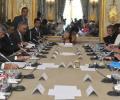
France on Friday announced an investment of 2 billion Euros in India as Prime Minister Narendra Modi invited French companies to pump in money in technology in the fastest growing economy.

The conclave will be held at the national capital from April 18-22 and will be chaired by Army Chief Gen MM Naravane.

"We keep hearing that Pakistan is a 'victim of terrorism'. This is the country which is an arsonist disguising itself as a fire-fighter. Pakistan nurtures terrorists in their backyard in the hope that they will only harm their neighbours," India's first secretary Sneha Dubey said in the UN General Assembly on Friday.

The Modi government finds itself in a contradiction of its own making. It has encouraged pro-Russian, Westophobic public sentiment while setting strategic policy that's exactly the opposite, points out Shekhar Gupta.

The strategic pacts were inked after the summit between Prime Minister Narendra Modi and his Japanese counterpart Shinzo Abe during which they also discussed international and regional issues of mutual importance including UN security reforms.

'India has a strong and proud tradition of strategic autonomy, and we respect that'

Jaishankar said all members would agree that India's approach should be guided by its national beliefs and values, national interest and by its national strategy.

'Supplies should start moving to the Serum Institute without any impediments.'
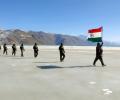
India has told China not to "shift goalposts" and "confuse" managing the border affairs and restoring peace at the frontiers with the larger issue of the resolution of the boundary question, which is dealt with by different designated mechanisms.

Modi, in a statement before his two-day visit to Bishkek from June 13-14, said that on the sidelines of the SCO Summit, he also plans to meet several leaders, including Russian President Vladimir Putin and Chinese President Xi Jinping.

President Kovind, who arrived in Dhaka earlier in the day on his maiden State visit at the invitation of his counterpart M Abdul Hamid to attend the golden jubilee celebrations of Bangladesh's independence from Pakistan in 1971, held delegation-level talks with him which was followed by a banquet.
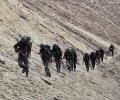
Citing media reports that China has built shelters in the Depsang area in Ladakh, the Congress on Saturday questioned the government's 'silence' over the issue and asked what steps were being taken by it to ensure status quo ante of April 2020.
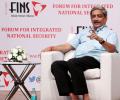
Former NSA Shivshankar Menon said the defence minister did not have a right to voice his personal opinion on nuclear policy in public, particularly when that opinion contradicted the country's official policy.
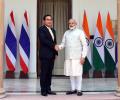
Thailand's importance to India's Act East policy is too significant to be overlooked.

The start of Indian lobbying in the US can be traced back to Pakistan's anti-India lobbying. Policy wonk Ashok Sharma documents this journey and its catalytic role in transforming the US-India relationship.

He said India has also opened its defence industry 'like never before' and sought investments in the sector.
The country opened its airspace for all flights except for New Delhi, Bangkok and Kuala Lumpur on March 27.
Against the backdrop of growing Chinese assertion in the Asia-Pacific region, India on Thursday said it supports the "freedom of navigation" in international waters noting that any disputes or differences in the region must be resolved diplomatically.

Opposition leaders urged Modi to use the opportunity for the country's benefit.

Since 2016, when India was officially recognised in US law as a 'major defence partner', Washington has purposefully upgraded the defence relationship.

Indians at large harbour a notion that their country is cherrypicking out of the American basket of goodies, but the policymakers in Delhi and the political leadership are well aware that it can only be a pipe dream since a military alliance with a superpower is a profound irrevocable commitment, observes Ambassador M K Bhadrakumar.
 © 2026 Rediff.com - Advertise with us - Disclaimer - Privacy Policy - Sitemap - Feedback - About us - Terms of use - Grievances